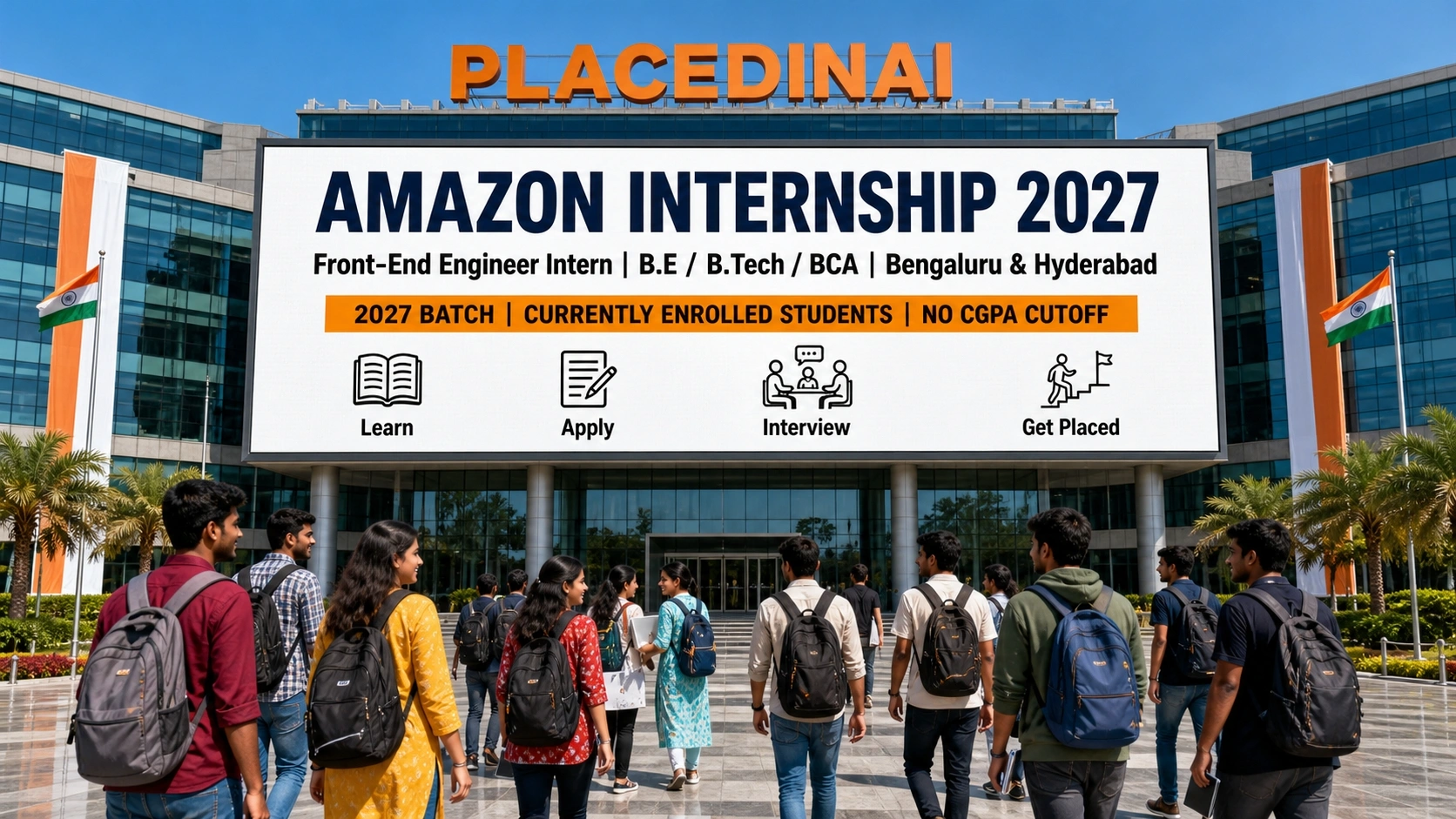
Amazon Front-End Engineer Intern 2027: who’s actually eligible, and how to prepare
Amazon opened Front-End Engineer Intern applications for the 2027 batch under Job ID 10502000, posted out of ADCI HYD 13 SEZ. One application covers every India location Amazon hires interns for. The posting names Bengaluru and Hyderabad and says the list isn’t exhaustive.
Before you read the requirements and talk yourself out of applying, read the next section.
The posting contradicts itself, and it matters
Amazon’s job description asks for experience building scalable distributed front-end experiences, reusable UX component libraries, demonstrated leadership in an engineering environment, and proficiency in automated browser testing. No undergraduate has that combination.
Then the actual Basic Qualifications field says: “Are enrolled in a Bachelor’s degree.” The preferred qualification is knowledge of CS fundamentals, meaning data structures, algorithms and object-oriented design.
What happened is straightforward. Amazon reused requirement text from its full-time Front-End Engineer posting inside an intern req. The only binding requirement is the short one in the Basic Qualifications field. If you are a current B.Tech, BE or BCA student graduating in 2027, you know JavaScript, HTML and CSS, and you have built a few React projects, you are eligible. The long list is a description of the work.
I’m flagging this because self-rejection is the single biggest reason students miss Amazon intern cycles. Recruiters don’t see the candidates who never clicked apply.
Role snapshot
Company Amazon (ADCI)
Role Front-End Engineer Intern, 2027 batch
Job ID 10502000
Locations Bengaluru, Hyderabad, and other India sites
Eligibility Currently enrolled in a Bachelor’s degree
Stipend Not stated in the posting
Apply via amazon.jobs
What the work involves
Front-end engineering on Amazon’s catalog systems. The catalog is the layer that holds product data for one of the largest consumer selections online, and the interfaces built on top of it are used internally at scale, so the work tends to be real production code.
What actually gets you through the interview
The posting names React, Angular, jQuery and Thymeleaf. You don’t need all four. React by itself is enough for an intern application. Thymeleaf is a Java server-side templating engine that appears in older internal tooling and no interviewer expects a student to know it. jQuery is legacy maintenance. Don’t spend a weekend learning either one for this.
The Amazon intern loop is coding plus front-end plus Leadership Principles. It is not a framework trivia quiz. Prioritise in this order.
Data structures and algorithms: Arrays, strings, hashmaps, trees, recursion, and basic dynamic programming, solved while explaining your reasoning out loud. Amazon’s intern questions skew medium difficulty rather than exotic. Consistency beats cleverness here.
JavaScript fundamentals interviewers genuinely probe: Closures. How this binds. Promises and async/await. The event loop, including the difference between microtasks and macrotasks. Event delegation. Writing debounce and throttle from scratch without looking anything up. These come up repeatedly and they separate people who learned React from people who learned JavaScript.
Two or three deployed projects you can defend: Not six abandoned repos. One live project you can talk about for fifteen minutes carries more weight: why you structured components that way, what state management you chose and what you rejected, what broke in production and how you diagnosed it. Have the URL and the GitHub link ready.
CSS layout without a framework: Flexbox and grid, and a clear answer when someone asks you to make something responsive without reaching for Tailwind or Bootstrap.
Leadership Principles: Prepare four real stories in STAR format. Interns get asked about Customer Obsession, Learn and Be Curious, Dive Deep and Ownership more than the rest. This round eliminates more candidates than students expect, because most people prepare only the coding half and then improvise here. Improvising does not work with trained Amazon interviewers.
Stipend
Amazon did not list a stipend in this posting, so I’m not going to put a number on it. Amazon India engineering internships have historically paid at the higher end of the market, but figures circulating on forums and Telegram groups are unverified and often years out of date. Ask your recruiter directly once you’re in the process. Treat any specific number you see online as a rumour until Amazon tells you.
How to apply safely
Apply only through amazon.jobs using Job ID 10502000. Amazon charges nothing at any stage of hiring: no registration fee, no assessment fee, no training deposit, no paid referral. Anyone asking for money in connection with an Amazon internship is running a scam, including accounts that clone Amazon branding on WhatsApp and Telegram.
Use a laptop rather than a phone. Keep your resume to one page and put your project links near the top where a recruiter scanning for ten seconds will see them.
If you need a workplace accommodation during the application or interview process, Amazon documents the request path at amazon.jobs/content/en/how-we-hire/accommodations.
My honest read on whether to apply
For a 2027-batch student, apply. A return offer secured in your third year removes the entire placement-season scramble in your fourth, and Amazon converts a meaningful share of its interns. Even without conversion, production front-end work at Amazon scale gives you something specific to discuss in every interview you sit for afterward, which is worth more than the stipend.
The one real caveat: specialising in front-end early can narrow your options if you’re still figuring out what you want to build. If that’s you, apply to the general SDE intern req as well. They are separate postings and applying to one does not affect the other.
FAQ
Can second-year students apply?
The stated requirement is current enrolment in a Bachelor’s degree, so second-year students are not excluded on paper. In practice Amazon fills these with pre-final year students, since the internship feeds full-time conversion. Apply anyway if you’re in second year and your projects are strong.
Is a CGPA cutoff mentioned?
No CGPA requirement appears in this posting.
Do I need React specifically?
No. The posting accepts several frameworks. React is the most useful choice for interview conversations because it’s what most interviewers will know deeply.
Is this remote?
The posting does not describe it as remote. Amazon India internships are generally in-office at the assigned site.
When does it close?
Amazon does not publish a closing date on this req. Intern postings fill fast, so apply within days rather than weeks.